

Dying with dignity
A review of Hale and Williams "Do we Have the right to Die?"

I’ve been intending to get back into thinking aloud in this forum. It looks as though we’re going to go through the whole assisted suicide debate again in the next parliamentary session, and so I want to take some time to think this through by way of a review of Do we Have the Right to Die? by Brenda Hale and Rowan Williams. This will be in two parts, with this first part focussing mainly on Lady Hale’s contribution.
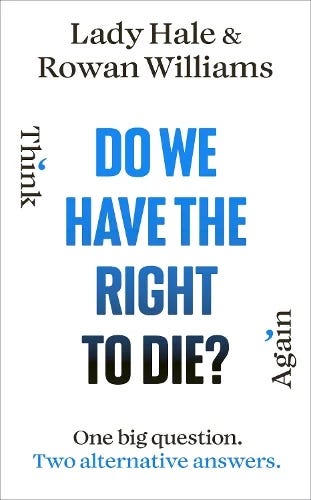
I’m a fan of civilized conversation and courteous disagreement, and was pleased to come across this book. It’s especially valuable as it looks as though we’re shortly to be repeating the attempt to shove a Private Member’s Bill through Parliament. Last time was bad-tempered enough, and each side accused the other of bad faith as well as bad arguments. The early signs are that this time round it will be worse, and arguably not a debate at all. I decided I would try to get my thoughts in some order by way of reviewing the book.
A couple of preliminaries. There can’t be many people who approach this without having a view themselves. Many approach the subject after encountering either good or bad end-of-life care; views can be strongly held, having been shaped by profound experiences. Let me note my own. First, my view grows strongly out of my Christian conviction that a human life is of infinite value, that life is fundamentally gift, and that death is not the end. This is no more and no less a faith based argument than those who argue from a conviction that the ultimate value is personal autonomy and freedom. None of us stand in a value-neutral space.
Second, my views are shaped by my experience of sitting with dying people, in home, hospital and hospice, and that process of accompaniment has been varied. Dying people approach their death in varying ways and at different paces. Some are readier than others; there is a spectrum between resisting and embracing it. There is no obvious or simple correlation between pain and readiness to die. I have not seen someone going through a prolonged (as opposed to occasional) period of pain that has not been able to be managed well by medication. That doesn’t mean it doesn’t happen, just that it lies outside my experience, and the testimony of hospice staff seems to be that it is rare.
Baroness Hale’s argument provides the first half of the book. In her preliminaries, she notes that three articles from the European Convention on Human Rights (currently incorporated into British Law through the 1998 Human Rights Act) are relevant to court hearings on this topic. These are 2, the right to life, 3, the prohibition of torture, and 8, the right to privacy and family life. It is this last the features most significantly in her argument. She does not particularly argue why assisted dying or assisted suicide are covered by article 8, it is more that she finds it self-evident.
Noting the cases of Paul Lamb and Tony Nicklinson, she reveals that she is in a minority of two among the nine Supreme Court justices in thinking that the ban on assisted suicide is incompatible with article 8. It would have been good to hear this argued rather than stated. There is a certain polemic among conservatives, initially fed by Roe v Wade, that the right to privacy has been used by what they would label “activist judges”. The US situation doesn’t pertain in this country, but the rhetoric around it can still fuel conspiracy theories about judicial activism from those who don’t like applications or interpretations of law that go against their convictions.
Lady Hale proceeds through a review of a number of such difficult cases from this century, and sums up the present state of the law in England and Wales. There are two forms of dying where the law does not allow individuals to exercise personal choice and freedom. (Personal freedom and autonomy seems to be her guiding star.) As she puts it:
“We are not free to have others help us to bring our lives to an end.
We are not free to have others bring our lives to an end.” p.36
By contrast, she rightly notes that we are free to refuse treatment, we are free to give a proxy the right to receive treatment on our behalf, and we are free to end our own lives. I would add that allowing someone to die by not intervening (ventilation, forced feeding etc) is a different moral, as well as legal, category.
She then turns to the case of Canada, on the grounds that their law used to be similar to ours. I find this a brave decision: of all the places that have changed the law to allow assisted dying, Oregon (which she doesn’t look at) comes closest to refuting the slippery slope argument of opponents. Canada exemplifies the slippery slope, but that doesn’t seem to trouble her unduly, even while she notes the ways the law is being both expanded and challenged. “Difficult though it is to get the answers right first time, we could do well to learn from their example.” (p.47) The problem is, every wrong answer may be a person killed who, perhaps, should not have been. The appeals process can’t undo that.
Next, she turns to public opinion and notes how it has been shifting over time, meaning that the question (before Parliament as she writes) is being asked in a different context. That does lend support to those campaigning for this change, and shows how much of an uphill struggle those of us against it face. Nonetheless, I can’t help wonder how many of those who cite public opinion on this, would bitterly oppose the same public opinion on the death penalty.
Baroness Hale deals surprisingly briefly with the underlying issues, perhaps because for her it is self-evident that an adult with mental capacity has the right to do what they want with their own body including killing themselves. She hints at the possibility of exceptions when she talks about preventing someone jumping off a bridge, but doesn’t explore them sufficiently. (I assume she would have agreed with the German courts that Bernd Brandes’ right to choose to be eaten didn’t absolve his cannibalistic killer of murder.)
It is disagreement over this question of the limits of personal autonomy that lies at the heart of the debate, and it is at best disingenuous that she outs herself as a Christian in order to co-opt the example of Jesus choosing the cross in favour of her argument. Being willing to die to save others (the conventional Christian understanding of the cross) is a different ethical and legal category, as countless memorials up and down the country testify. And, of course, for those who don’t share the Christian understanding of this, he was either a mistaken martyr, or an unwilling victim of an oppressive imperial state. Perhaps, as well as asking the humanist leader Andrew Copson to check her argument, she should have consulted more widely.
For the rest of her essay, Lady Hale looks at the practicalities of the legislation. Here she makes a number of helpful and clarifying points in relation to what a good bill might need to deal with. It becomes clear that she would prefer a bill in which eligibility is more widely drawn. The cases with which she began were mainly about the intolerability of long-term, and degenerative conditions which this once and future bill would fail to address. One point I hadn’t appreciated (and I suspect I’m far from alone in this) is that the clause providing that “no person is under any duty to participate in the provision of assistance in accordance with this Act” (p.73) would normally be interpreted in the courts as including legal persons — thereby allowing charities like hospices, to refuse to offer assisted suicide.
She also suggests that judicial safeguards would be better handled by the local judges who serve in the court of protection, the family courts, and mental health tribunals – an option that makes more sense to me than the proposals in the Leadbetter bill. In general, she discusses issues, rather than coming to a settled view on them. I think, though, that she underestimates the ability of families and others to exercise soft power and to gaslight when she explores how one legislates against coercion.
Interestingly, in the end, she is clearly in favour of the principle, but can’t make up her mind whether she would want to vote for such a limited bill with what she sees as “elaborate and time-consuming safeguards” (p.79). I suspect this is also the true view of many of the bill’s supporters. This is not the bill they want, and if they do vote for it, it will be as a first step in getting the principle enshrined in law. At least Lady Hale has said the quiet part out loud.
Next time, I shall turn to Lord Williams contribution.