

Dignity in dying
A review of the book coauthored by Lady Hale and Lord Williams

Yesterday, I published the first half of my review of Do we Have the Right to Die? by Brenda Hale and Rowan Williams. In that post, I covered the first half of the book, authored by Lady Hale, making the case for assisted suicide, though being at best (and with a following wind) lukewarm over the proposed Leadbeater legislation, which she has since spoken more clearly about disliking. Today, I look at the second half of the book, where Lord Williams makes his case against the legislation in principle.
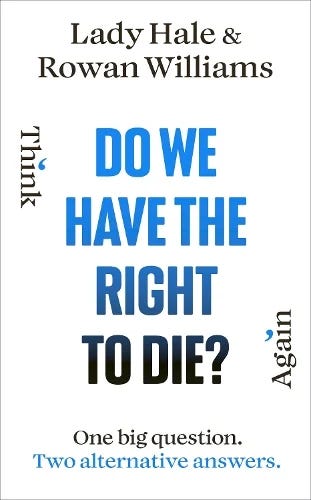
Lord Williams characteristically begins by seeking to stake out some shared ground. He wants each side to be able to recognise that the other’s position is grounded in moral concern for the human person. He seems, though, rather to assume that some form of legislation in favour of assisted suicide will be passed, as he hopes that “any legislative outcome might try to retain some measure of recognition for those whose view has not prevailed but who remain part of the same society”. (p.84-5) It is hard to see how this can be the case without some form of assisted suicide being made legal, but with protection for the consciences of those who oppose it.
As part of this clearing of the decks, he also addresses the validity of religious argument in the light, particularly, of Esther Rantzen’s attempt to use religious conviction as a way of smearing her opponents’ arguments as made in bad faith. People root their arguments in their deepest convictions. However, in public debate about policy, they need to find arguments which persuade those who do not share those convictions. This is not bad faith, but the inevitable consequence of democratic debate in a pluralist society. “it is an attempt to find some common ground about the common good.” (p.90) He also notes that people such as his predecessor at Canterbury, Lady Hale, and Rabbi Jonathan Romain argue in favour of assisted suicide with (and in varying degrees from) their religious conviction.
Decks sufficiently cleared, the bishop moves on to discuss rights. Here he seeks to untangle some of the complexities of the “right to die”. This language is used in equivocal ways: he uses the examples of the right not to be enslaved, and the right to work. Law can ensure the first, it cannot command the economy. Governments do, in wartime or national emergency, constrain individual rights in favour of collective security though the limits and nature of those powers might be disputed. (He could give rather more weight to the dispute than he does.) Here also, he appears more in agreement with his sparring partner. What is it about having perhaps six months to live that confers the right to die, but having another kind of painful, life-limiting and irreversible condition does not confer that right? And (an argument repeated by many of the campaigners against this legislation) how does a society balance the rights of one individual to exercise their autonomous mental capacity to make such a decision against the protection of vulnerable groups who lack the ability so to do.
Bishop Williams moves from rights to risks. He notes that risk is recognised in the legislation itself; why else have safeguards? He takes Kim Leadbeater’s assurance that the bill is rigorous in this to be made in good faith but draws attention to the many groups including palliative care, psychiatric and disability specialist service who (to put it mildly) dispute this. He comes as close as he ever gets to a “j’accuse” moment against the organisation Dignity in Dying when he skewers their campaign for making the “ideal” case (the autonomous capable rational adult making a decision in face of an intolerable but short future with the full and unanimous support of friends and family) the “usual” one. How much is the abusive relationship, the controlling partner, the pressure of poverty, and family division glossed over in this marketing move? (I make explicit the sharper case hidden under his more emollient subclauses.) He ends this section with a question over the risks posed to the limited and stretched resources of the healthcare system.
Next, the bishop explores the question of priorities. The larger part of this argument concerns the cost of healthcare, and the lack of consistent palliative care. Good palliative care is something of a postcode lottery. There are those voices (the commentator Matthew Parris is one such, the MP Kit Malthouse seems to be another) who see noting wrong with triaging the dying in order to spend limited resources more effectively on those who might be expected to recover. Lord Williams – frustratingly in my view – does not address the ethics of this directly, but prefers to continue by indirect questioning. He draws attention to the way disability groups are overwhelmingly against the bill, and evidence from Canada and Oregon that poverty may play a part in encouraging or pressuring people to choose death. From these and others, he asks whether this provision encourages a society in which some lives are effectively less valuable than others.
As the final part of his argument, he turns to the slippery slope that Lady Hale seemed quite happy to slide down. He suggests there are both legitimate and illegitimate versions of this, and that, for him, a legitimate version is one where there are further steps that can (and possibly should) be taken arising from the same basic principle. If the principle is personal autonomy, why should it not extend to far more contexts? If the principle is the compassionate relief of intolerable suffering, why should it stop at physical suffering? And if both principles be combined, does seeking to prevent someone’s suicide become a violation of their human rights? At the end, he remains doubtful of framing this in terms of a right, even while he recognises it might be a freedom. The language of my right entails someone else’s responsibility. Can someone impose on a family member, a doctor, or even society, the duty to kill them, or even help them kill themselves?
The bishop seeks to draw all this together, first by returning to what he sees as a key point: if we are to change the law to aid a certain number of people (those who have less than six months to live and whose suffering is intolerable to them) we must be sure that change does not introduce worse consequences for other people (pressure on the poor to end their lives because they cannot afford the care they need to make them tolerable).
Seeking a dialectical approach as always, Lord Williams then seeks to establish what he hopes might be common ground between the opposed sides. “If there is to be a choice,” he says, “let it be a fair one in which palliative options are both taken with full seriousness and given full support.” (p.147 - given some of the stances taken by Lord Falconer and Kit Malthouse this seems generous to a fault!) His second point is the most interesting: that there is a genuine recognition on all sides that there is such thing as a good death. What might come of exploring this further? He tentatively advances a third, the idea that death is not the worst thing imaginable in a human life, though the grounds on which such a view is held might differ wildly.
It is with this last point that I register my own disappointment with Bishop Rowan’s argument. While Lady Hale was prepared to assert a poor theological argument for her view, Lord Williams offers none, weak or strong. True, he has earlier stated that he is seeking arguments that might persuade those who do not share his first principles, but I think he could do more to set out what those principles are, and why a theological vision of human dignity might be compelling. The church has a long pastoral and spiritual tradition of what a good death is, and how the last enemy can be befriended by those who recognise it has already been defeated. Perhaps a profound, poetic and culturally relevant articulation of that tradition might in itself have some persuading power, and might also demonstrate that this is not simply about legal and medical calculus, but about differing visions of humanity.
That said, both Lady Hale and Lord Williams offer thoughtful and careful statements of their respective cases, with courtesy and fairness to those they disagree with, and if more did the same, this debate could be considerably better. I do, however, think the format of the book would have been considerably improved if each had been allowed a short response to the other. Perhaps if each had been asked to identify the single strongest, and the two weakest, points the other has made, it would have helped clarify matters, enhance the sense of debate, and further stimulate the reader’s thinking.
For those who would like to see them debate each other, then this interview is well worth watching.